How did I get published? Part Four

Standard

It took about three years in order to secure those first book contracts.  I don’t think I’ve ever worked so hard to carve out a career for myself as a writer and illustrator.

The final footnote to this story involves why I was never published by Harper & Row.

During the two years that I was constantly drawing specific “ideas” for T—-, it never occurred to me that nothing would ever come of it.   As Fate would have it, one day when I was bringing in another batch of requested drawings to show that I could draw ‘whatever’, I bumped into the editor who had the office next door to T—-.

Her name was B—-.   We literally bumped into one another and when she figured out who I was she burst out with “I love your work!  If T—- doesn’t want to work with you, I would love to!”

I was astounded!   Here was an editor that I had never met, but who had seen all those drawings I had been slaving over and she was excited about my work!

B—- invited me into her office and explained to me that she worked for a subsidiary publishing house at Harper & Row called Thomas Y. Crowell.  Her speciality was nonfiction picture books.

She said: “If I knew you could write nonfiction I’d offer you a contract on the spot!”

I replied: “I can write nonfiction!  In fact, I would love to write a nonfiction picture book on a fascinating prehistoric village that I visited in 1978 and have gone back to explore every year since!”

B—- said: “Well, if you want to show me a manuscript about it, I’d love to read it.”

This was a Friday.  I took the train back to Philadelphia and spent the weekend writing my first nonfiction manuscript titled: Skara Brae: The Story of a Prehistoric Village.  

I called B—- first thing Monday morning and announced that I had finished the nonfiction manuscript.

B—- said:  “You’re kidding?  YOU wrote an entire nonfiction manuscript about an archaeological site over the weekend?”

I replied:  “Yes, I did.  And it’s good.  I know the story of this village and how I’d like to tell it like the back of my hand.”

We made arrangements for me to take the train the next day back to her office so that I could show her the manuscript.

B—- read the manuscript while I sat quietly in her office.  When she finished she took off her glasses and put the manuscript down.

“This is really good,” she said.  “I want to publish it.  Do you have any sketches of this place?”

Of course I had sketches!  Tons of them!

After looking at the sketches and glancing through the manuscript again B—- went on to say:  “I not only want to offer you a contract for Skara Brae, but I would like to offer you a second contract for you to write a nonfiction book for children as to just HOW an archaeological dig is done; how a site is uncovered/discovered, and all that.  Think you could do it?

Naturally, I said “Of course, I can!  But, I will need a bit more time to do some research in order to come up with just the right way to tell the story as to how an archaeological dig is done.”

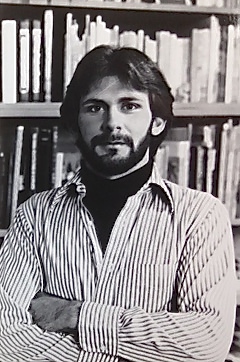
And this is my first author photo published on the back inside flap of Skara Brae:

3

I tried very hard to look like a serious writer to be taken seriously!

Note:  It never occurred to me that editors were in competition with one another in securing manuscripts, writers, and illustrators.  I learned that T—- never really did have any real interest in publishing my work, but she thought I had talent and she didn’t want another editor to offer me a contract.  It was a hard lesson learned, but I learned it well.

So, now I had contracts for Eddy B, Pigboy and TWO nonfiction picture books.  I had one last appointment to meet with an editor at an independent publishing house called Holiday House.

M—– was as energetic and enthusiastic about books as I am.  She was tall and angular and was one of the most talkative editors I’ve ever met.  When I arrived for our late afternoon meeting I was so excited as to how my day had gone that I had to tell her my great news!  I was being published by two editors!

M—– was taken aback with the news and jumped right onboard.

“WHAT projects do you have left that haven’t been signed up?  I want them!”

And that’s how Ravena (No One Will Come to Dinner) was signed under contract along with Mogwogs on the March!, Fergus and Bridey, and a blank contract to be filled in when I had a manuscript.

During the course of one week I signed seven book contracts!

I never did fill out that application for the Wharton Business School.  I still wonder IF I ever had a chance of getting accepted.  But, then again, why wouldn’t they have accepted me???

*****

How did I get published: Part Three

Standard

I didn’t return to New York City until a few weeks later in order to follow-up with several of the editors.   I worked on my portfolio, took out pieces that had nothing to do with book illustration, and took the train from 30th Street Station in Philadelphia to Penn Station in New York City—by myself!

Of all the editors and art directors I had met Charlotte Zolotow was the most encouraging.   She had me meet with an up-and-coming editor named T—- whom she thought might be a good fit for me and who might be interested in working with me as a writer and illustrator.

T—- was young, sophisticated, and very interested in my work.  During my first meeting with her she asked one important question:  “Did you know what children’s picture book is considered to be the most perfect picture book?”

I had no clue.  I loved quite a few children’s books and had my favorites, but I didn’t know that there was ONE perfect picture book.

“Goodnight, Moon,” she said.  “I want you to study this book and see if you can figure out why it is considered to be the perfect picture book.”

T—- and I had many meetings over the next few months.  I felt like I had made an entrée into the world of children’s book publishing even though I had not yet been offered any kind of contract.

T—- read several of my manuscripts and had said “I wish I could tell you to concentrate on illustrating alone, but your writing is really good.  You’re almost there.”

“Well, tell me what to do to be there and I’ll do it!” I had said, feeling a bit frustrated.

“I can’t,” she said.  “It’s something you’re going to have to figure out for yourself and when you do, you’ll be there, and I will want to work with you on a project.”

Believe it or not, this kind of exchange went on from 1979 until 1981.  I stopped making appointments with other editors and art directors because I really thought that Harper & Row was going to be MY publisher.   Charlotte continued to be interested in my progress but left me in the “capable hands” of T—-.

T—- kept asking me questions like: “Can you draw sheep?  Do you think you could do a few dozen sketches of sheep and bring them to me in a couple weeks?  I have a manuscript that you might be just right for.”

I frantically drew sheep and went back to see T—-.

“Can you draw fish and whales?”

“Can you draw city scenes?”

“Can you draw….”

Over the course of two years I must have drawn hundreds of things that T—- asked to see.  But it never seemed to get me any closer to being offered a contract.

Working all day in an office and staying up most of the night drawing whatever T—- requested me to draw, was starting to take its toll on me.  I was exhausted!  But most of all, I was frustrated.

This is when Ed came to my rescue.

I told him that I really needed more time to work on my portfolio and that I needed to make appointments and talk to other editors.  He agreed.   Ed is a talented watercolorist and has always been my toughest critic.   We made a deal:  I would quit my job and would take a year off to work on my portfolio.  I had listened to everything every editor and art director had said to me, especially Charlotte and T—-, and now I knew that I really had to work on a focused manuscript and dummy.

Ed would support me financially for a year.  And at the end of the year IF I did not get my break in publishing, I would apply to Wharton, get my MBA, and put all thoughts of being a professional writer and illustrator behind me.  I would be one tough, kick ass CEO in a corporation.

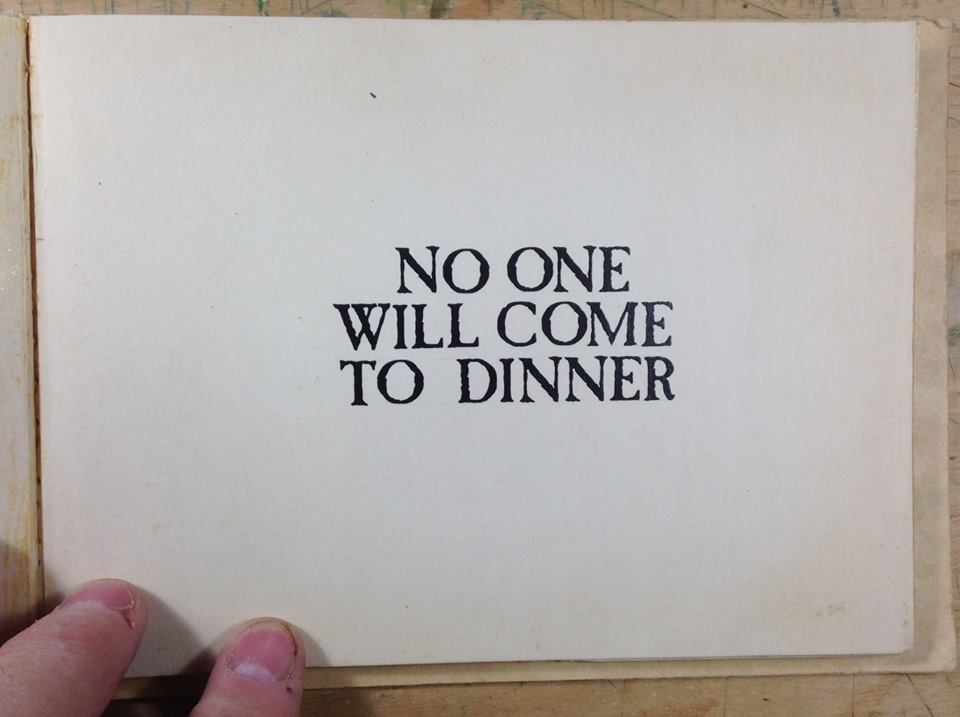
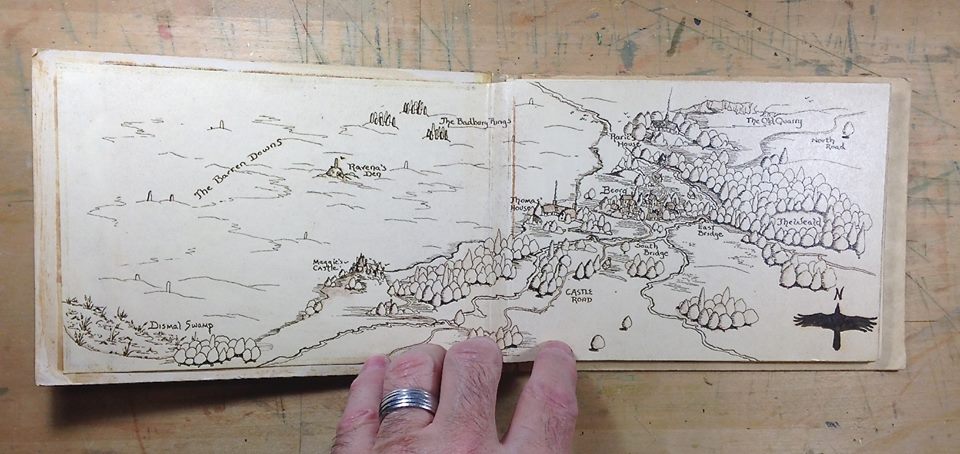
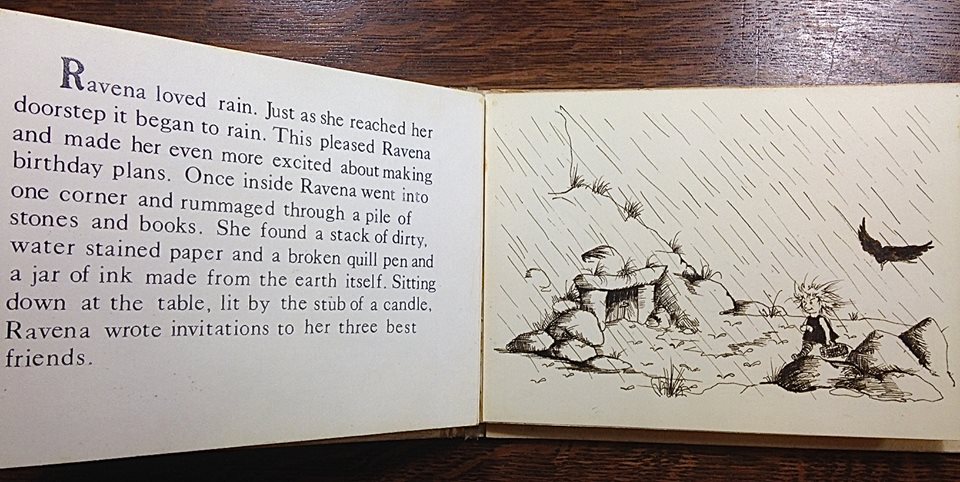
From 1981 through most of 1982 I worked on No One Will Come to Dinner.  A quirky story about a small Scottish banshee that didn’t quite fit in with her clan.  I wrote the best story that I could telling of her the little banshee’s adventures and determination to live on her own away from her clan called the Ravenlocks.  The small banshee’s name was Ravena.

I spent a great deal of time in bookstores (back then there actually WERE bookstores that you could visit and look at books for as long as you liked.   There were no cafés in the bookstores, only books).  One of my favorite illustrators is Trina Schart Hyman.  And one of my most favorite books that she illustrated is titled Magic in the Mist written by Margaret Mary Kimmel.

I read and reread that book at least 200 times.  I studied every illustration and layout of the book.   When I made my first dummy for No One Will Come to Dinner I basically used Trina’s layouts to inspire my own book design layout.

I still have that very first dummy.

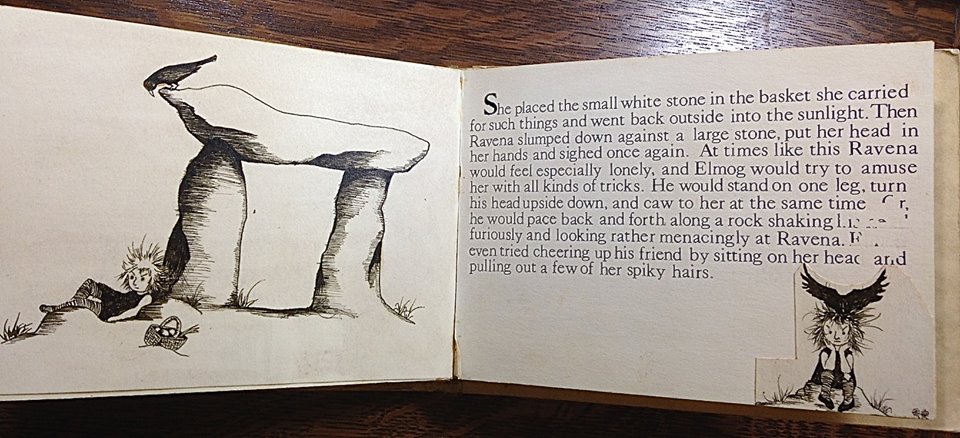
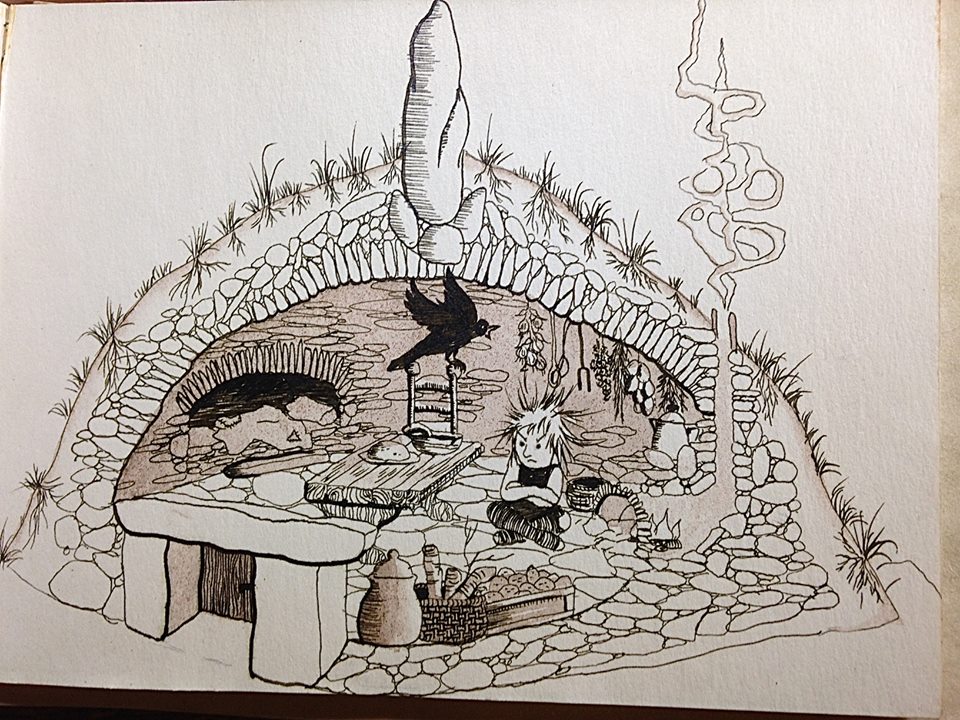
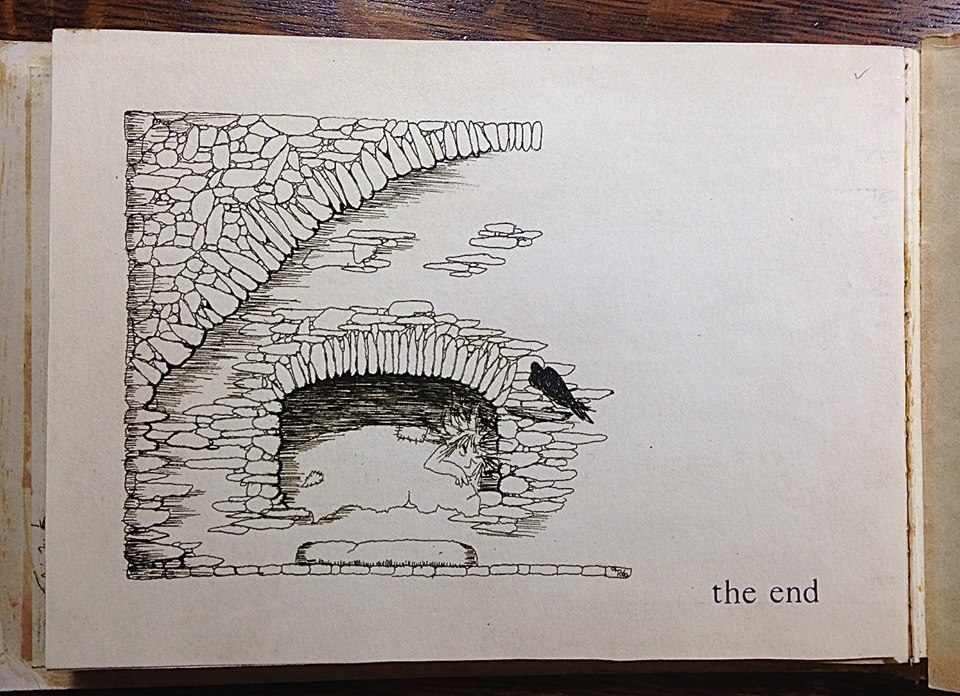
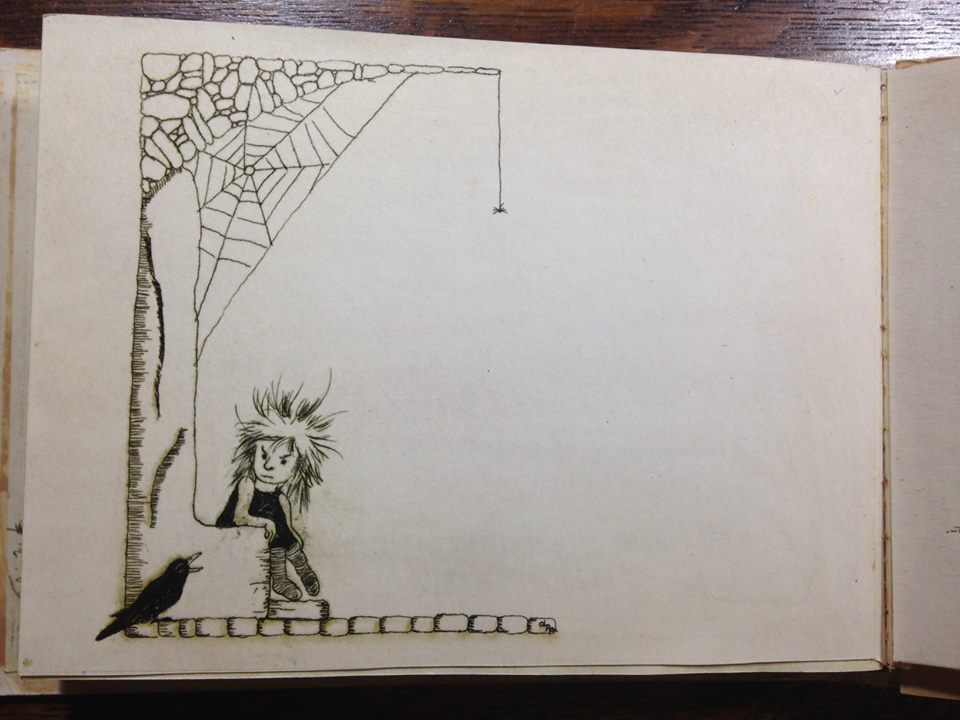
10167928_10203269590757873_4480451164453692962_n

10013041_10203269597318037_8684947963573832083_n

10246772_10203269600358113_7243046268744776343_n10245545_10203269599238085_8542055773032651168_n

10172600_10203269601798149_3124609869141949149_n10253844_10203269603718197_1612105563406657911_n10151883_10203269603038180_3618380613285980695_n

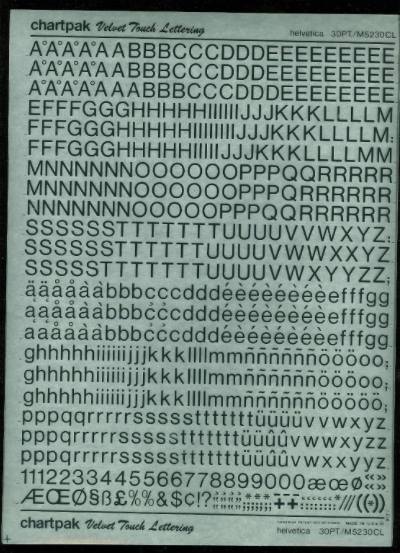
In 1979-81 we didn’t have personal computers.  The only way to make the words in the dummy look “professional” was to buy sheets of Chartpak rub-on letters.  In this dummy every single letter of every single word and punctuation was carefully positioned and rubbed onto the paper in the most painstaking manner you can imagine.

Here’s what a sheet of Chartpak letters looks like:

1546237_10203275748111803_8224682645734403252_n

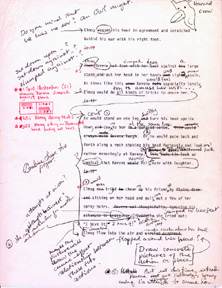
And here is that very first manuscript!

manuscript

In the beginning of my career I was a messy writer!

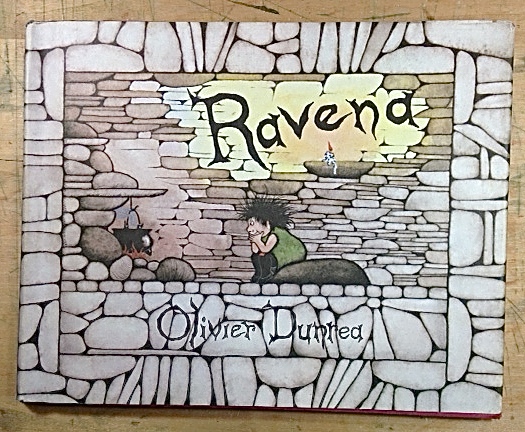
No One Will Come to Dinner was published as Ravena in 1984.

Front Cover

But, I’m getting a little ahead of myself in telling the chronology of my  publishing story.

It was 1981, my time was running, money was tight, and I had to start taking temp work as a secretary/administrative assistant.  Ed had been patient, but my break hadn’t come yet and it looked like the year that I had given myself was coming to an end and i would have to start filling out the application for Wharton Business School.

I am an honest person.  Or, so I like to think I am.  Back in those days we didn’t have unlimited long distance calling.  Every time I called an editor or publisher in New York City it was a long distance call.  And I really couldn’t afford to make many long distance calls.

I was working in an office and had a moment of panic.  I only had  two weeks left before my time would run out and I would have to honor my promise to Ed and give up my dreams of being a published writer and illustrator.

I did something not very ethical.  I used the phone in the office that I was temping in to make a few long distance phone calls to publishers in New York City.  I thought if I’m not going to make it at least I’m going to give it one last try so that I could always say:  “I tried, but I wasn’t good enough.”

I made appointments with four publishers.  I won’t drag this part of the story out but let the record show that when I returned to New York City for my final swan song I was offered SEVEN book contracts by these four publishers!

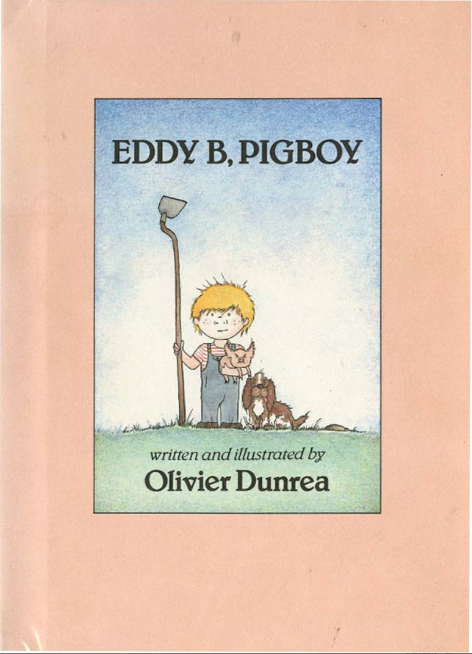
It was amazing!  Ravena was the first book that I worked hardest  on, but it was Eddy B, Pigboy that was the first book to be published by Margaret K. McElderry at Atheneum.

Screen Shot 2015-01-04 at 8.26.57 PM

It was this little 5″x7″ book that launched my career as both a writer and illustrator.

I signed the seven book contracts in 1982.  Eddy B, Pigboy was published in 1983.

At the time I never thought it might be unusual to have been offered so many contracts at one time before I had ever had anything published.   But, that’s the way it happened.

*****

How did I get Published? Part Two

Standard

My first meeting with a bonafide, hardbitten, uninterested NYC editor didn’t deflate my enthusiasm.  My work simply held no interest for her.

Charlotte Zolotow (whom I knew as the writer of one of my favorite books, William’s Doll) was the complete opposite of the editor named N—-.  She was warm, friendly, made me feel welcome, and started the conversation with “I can’t wait to see what is in that portfolio!”

The old school editors were not hesitant to show a bit of enthusiasm and encouragement to would-be prospective writers and illustrators.  1979 was the beginning of the end of the Golden Era in children’s book publishing.   There were still numerous publishers, both large corporations and the smaller independent publishers such as Holiday House and Houghton Mifflin.  All this would change in the course of the next few years and publishing houses began merging and becoming huge conglomerates.

Charlotte, as she had instructed me to call her, had her assistant, S—- bring us coffee and some pastries.  S—-was a startling handsome and VERY New York young man.  Very friendly.

Charlotte took her time looking at my portfolio.  She paused over each piece that I had carefully chosen to include (hoping to highlight whatever talent I might have) and asked insightful questions as to why I had included such-and-such a piece, where did my ideas come from, and how did I see myself in the world of children’s book publishing.

She made me feel special.  She made me feel that she was interested in my work.

After about twenty minutes or so.  She closed my portfolio, took a sip of her coffee, and looked straight at me.   What followed next were words that I would carry with me throughout my career as a children’s book writer and illustrator.  Her words gave me hope.

“You are very talented,” Charlotte said.  “One day you are going to be quite famous.  There is that something extra in your work that is unique and appealing.  However, you have no idea what this business is all about.”

She went on to tell me that I was showing set design, costume design, whimsical drawings and studies, etc.  Her big question was: “Do you really want to do children’s books?”

“Yes!” I had exclaimed.

“Well, here is my suggestion: look at what is being published, familiarize yourself with what books are being published by which publishers.   See if you can figure out where you might fit into the scheme of things.”

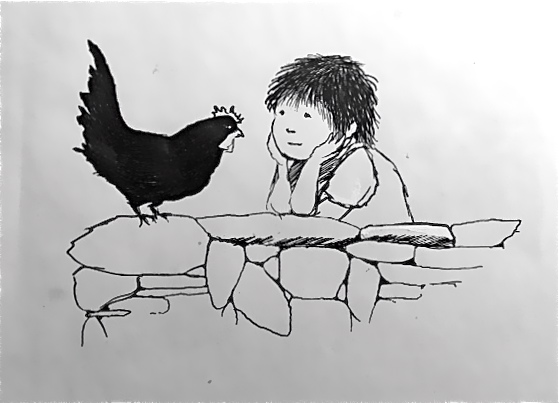
There was one small pen-and-ink drawing that I had put in my portfolio hoping that it looked like a “classic” black-and-white children’s illustration.

Charlotte opened my portfolio and tapped her finger on that small drawing, which is no larger than 5″x7″, if that.

“This is the best thing in your portfolio,” she said. “It speaks volumes.  It intrigues me to ask ‘what is the story?’  I want you to see if you can see why this sketch is so magical and try to capture its essence in future sketches and artwork.”

Here is that drawing.  I have it a small frame that sits in a bookcase in the Lincoln Room here at Henwoodie.

Chicken Talk

As rough as this sketch is Charlotte Zolotow saw something that appealed to her sensibility as an editor.

After we had finished talking she studied me and her next question caught me completely offguard:  “May I ask what your plans are for lunch?  I’d like to take you out to lunch if you’re free and talk a bit more.”

Without thinking I blurted out “I’m busy!  I can’t do lunch!  I have five other appointments to keep and this is my first time in New York City and I’m having lunch with Ed somewhere on Lexington Avenue!”

Charlotte laughed and said “I see.  Here’s my card, check with Ed and see if he would mind terribly if the three of us had lunch.”

I thanked her for her time and took her card.  She asked if I had any questions before leaving.

“Just one,” I said.  “How do I get to Third Avenue from here?  I need to find the offices of Macmillan.?

Charlotte laughed and asked S—- to show me to the elevator and ride down with me and show me which way Third Avenue was.  Needless to say, I felt relieved and grateful and assumed that this is how everyone’s first meeting with an editor went.

In the elevator S—- told me that Charlotte must have been impressed with me to go through so much trouble.  He gave me a wink, squeezed my butt, and when we reached the lobby he walked outside and pointed out the direction that I should go in order to get to Third Avenue.

Ed was waiting for me on the sidewalk but had the good sense not to come over while I was being given directions.

“Who was that?” Ed had asked.

I told him who S—- was and that I thought he must be gay and that he was VERY friendly in the elevator.  As we walked toward Third Avenue I told him how my very first meeting went and told him that Charlotte had invited us out to lunch, but I had told here that we had plans.

Ed stopped dead in his tracks.

“An editor wants to take you out to lunch and you told her you were busy?”

Ed couldn’t believe his ears.   He made me find a pay phone (this was decades before cell phones) and call Charlotte and tell her that I had checked my schedule and that I was free to have lunch with her, if she still wanted to.

When I called Charlotte (ten minutes after leaving her office) and explained to her that I was free to have lunch if she still wanted to.  She laughed and said that would be fine, but something had come up that required her immediate attention and she wondered if S—- could meet us for lunch and fill me in a bit more as to how Harper & Row and I might be a fit.

Lunch was great!  S—- was funny, had the strongest New York accent I had ever heard and regaled me and Ed with stories of his escapades at Studio 54, on Fire Island, and on the “docks”.

The rest of the day was a whirlwind of meeting with editors and art directors.  Ed and I returned to Philadelphia exhausted, but pleased with my first brush with New York City publishing.

*****

How did I get published? Part One

Standard

The one question almost every writer (and illustrator) I know gets asked is: How did you get published?  The obvious answer is that it is a different scenario for each and every writer.

In the next series of blog posts I am going to attempt to chronicle my own publishing story.  Most likely the telling will weave back and forth in time (as I remember specific details that I may have left out as I am furiously, frantically typing).

Note:  A good “background” story as to my first leanings to becoming a writer can be read in my autobiographical novel based on one of my journals that I wrote when I was 17 years old.  (I still have my first journal that I wrote when I was 12 years old).   The novel is titled: 4″ by Gabe Hooton.  I chose to write and publish this edgy, quirky, darkly humorous, compelling narrative under one of my pen name in order to avoid any conflict of interest with my children’s books.

If you like you can read 4″ in Amazon’s kindle store.  It’s a fast paced, in-the-moment, breathless kind of storytelling.

4″ basically covers the latter half of my senior year in high school.  It is the first book in a trilogy: 4″, 8″, 12″.  The three books cover exactly one year in my life and how my life drastically changed when I went off to college and Europe when I was 17 and 18 years old.

The first thing you should keep in mind when reading my publishing saga is the fact that I pretty much have always known I would be/wanted to be a writer (my mother’s dream for me was to be a waiter in a fancy restaurant—one letter in a word can make all the difference in the world:  waiter or writer.  I knew that being a waiter in any restaurant was NOT my ultimate goal in life.

I am the first person in my family to go off to college.  All through junior high and high school I thought of little else except getting into a good university and begin pursuing my goals in earnest.

Note: I had written out my “Life Plan” when I was 12 years old.  I am one of the most focused and determined people you might ever meet or want to meet.  Or NOT want to meet!

From that very first trip to Europe in January 1972 everything that I saw, experienced, ate, smelled affected my life and goals in a dramatic and momentous fashion.

I graduated with my bachelor’s degree in 1975 and ventured off to the west coast to work on my master’s.

I moved to Philadelphia in April 1976 after a disastrous love affair that nearly did me in (that is another story altogether).  I chose Philadelphia for two reasons:  1) to be closer to my mother who had remarried and was living in a suburb of Philadelphia called Drexel Hill and 2) to be within commuting distance of New York City without having to actually live there.

In July 1976 I met a handsome young architect (10 years older than me) named Ed and pursued him hard until he relented. I told him: “I know you don’t love me, but trust me, you’ll get used to me.”  He did.  I was 22 years old.

Ed’s influence on me was profound.  He is one of the most intelligent, intellectual, ivy-league educated people I know.  We are complete opposites in that he is very quiet, hardly talks, and is even more focused than I am.  He was a challenge.  He was also very talented.

Note:  I use the past tense for some odd reason.  Ed is still in my life.  We own Henwoodie together and have lived together for almost 40 years now!  We are no longer partners, but we are family.

Because of Ed’s influence on me I applied to, and was accepted, into the master’s program/doctoral program at the University of Virginia (where Ed had earned his degree in architecture).  I did not want to be an architect but I do love architecture, art history, and design and it seemed like the route I should go.

However…I was in a brand new relationship and I was torn between returning to graduate school (even for a few years) or remaining in Philadelphia and being in a happy, productive relationship.  I chose the latter and have no regrets whatsoever.

My reasoning was that I could always pursue a profession anywhere at any time, but I wasn’t so certain I would ever be as successful in a relationship.  My #1 Life Plan Rule is: My relationship and the person I love always comes first in any and all things.  My #2 Life Plan Rule is: My career always comes second and will never be put ahead of my partner/husband or relationship.  My #3 Life Plan Rule is: Friends and family are important but will never interfere with Rules #1 and #2.

I’ll explain in a bit why Ed played such a pivotal role in my career.

So, I’m in a happy relationship but not in grad school.  I have to find a job.  I wanted to understand Ed’s profession better, and be able to hold up my end of the conversation, therefore the most logical job choice was to seek employment in an architectural firm.  Not as an architect, but in an administrative capacity.

Note:  I said that Ed is one of the most intelligent and intellectual people I know.  For the first two years of our relationship I carried a pocket dictionary around with me in order to understand everything Ed said.  His vocabulary is extensive and far beyond most ordinary peoples’ understanding.  His feeling was that I was college educated and I should have a working knowledge of an educated vocabulary.

I’ve always said: If you can’t beat ’em, join ’em.  Ed increased my vocabulary thousandfold.

From 1977-1979 I worked for two wonderful, creative, liberal architectural firms in Philadelphia.  The architects I worked for were young (in their 30s), talented, open-minded, and remain friends to this day, all these years later.

I wasn’t unhappy managing these two small/midsize firms but it wasn’t where I wanted to be in my own career.  I did consider applying to Wharton Business School and earning my MBA, just in case I did pursue a professional administrative career.

And here is where Ed’s most direct influence changed my life.

Ed first took me to NYC in 1979 to make my very first attempt to get published.  I had never been to NYC but I had called and made appointments to show my portfolio and manuscripts to publishers such as Holiday House, Harper & Row (at that time), Macmillan, Atheneum, etc.

That very first trip to NYC was thrilling!  I was never nervous about showing my work or meeting editors and art directors.  I was too excited and too full of myself.  It never occurred to me that anyone MIGHT say “No” to me.

My very first appointment was in the morning at Harper & Row at 53rd Street and Fifth Avenue.   Ed waited on the sidewalk while I went up to my appointment.  When I stepped off the elevator into the high gloss glass and chrome lobby of Harper & Row the first thing I saw was one of the most elegant black woman sitting behind a huge desk.   She had an air of authority and don’t-mess-with-me attitude and the longest fingernails I had ever seen on any woman in my life.

Naturally, I assumed she was the president of the company.  I marched up to her desk, bold as brass, plunked my large portfolio on the floor beside me and announced to her in the most enthusiastic and not-to-be-ignored voice I could:  “Hi!  My name is Olivier Dunrea.  I’ve been in NYC for ten minutes and I want to be published!”

Without missing a beat with filing her long, elegant nails the woman looked me up and down and simply said:  “Yeah, baby, so do ten thousand other people.”

NOT to be put off or brushed aside I bravely continued my spiel.

“But, I’m NOT ten thousand other people!  I’m different!  And what I’m about to show you I promise you, you have never seen before.”

Just at that moment another elegant New York woman entered the lobby.  She was older, white, beautifully, impeccably dressed, and was carrying a fairly impressive pile of papers (manuscripts).

“Who are you?” she asked, as she looked me up and down.

Note:  I had worn my best beige corduroy suit in order to impress the sophisticated New York publishing folks.

“Hi!  My name is…,” I began all over again.  I hate my little speech down pat.

“Yes, yes, I heard your pitch.  What is it exactly you do?  And what do you want?  Are you an agent?”

“I want to be published1” I blurted out, abandoning my rehearsed speech.

“Well, that’s nice.  Who are you here to see?” she asked politely, but in an interested sort of way.

At this point she placed the pile of manuscripts on the black woman’s desk and asked her to please see that A—- and M— got them.

The elegant black woman was the receptionist, as I quickly figured out.

The older woman was none other than the renowned Charlotte Zolotow.  I told her who I was there to see and her response was:

“After you have shown your portfolio to N—, would you mind if I took a look?” she said.

“Sure!  I’ll show anyone who wants to see it!” I exclaimed unabashedly sure of myself.

“I like your enthusiasm and confidence,” Ms. Zolotow said.

The editor I had the appointment with breezed through my portfolio in about two minutes.  It was obvious that nothing caught her eye and she showed absolutely no interest in my work or listening to my pitch as to what she was looking at.  And she certainly had NO interest or intent or reading any of my manuscripts on the spot.

At the conclusion of our meeting I asked her where Ms. Zolotow’s office was located.  She pointed out the way to me and merely turned her back on me.  That was that.  I had met my first New York City editor.

*****
When do I write? In the dead of night…

Standard

People often ask me: “When do you actually do the writing that you do?”  Good question.

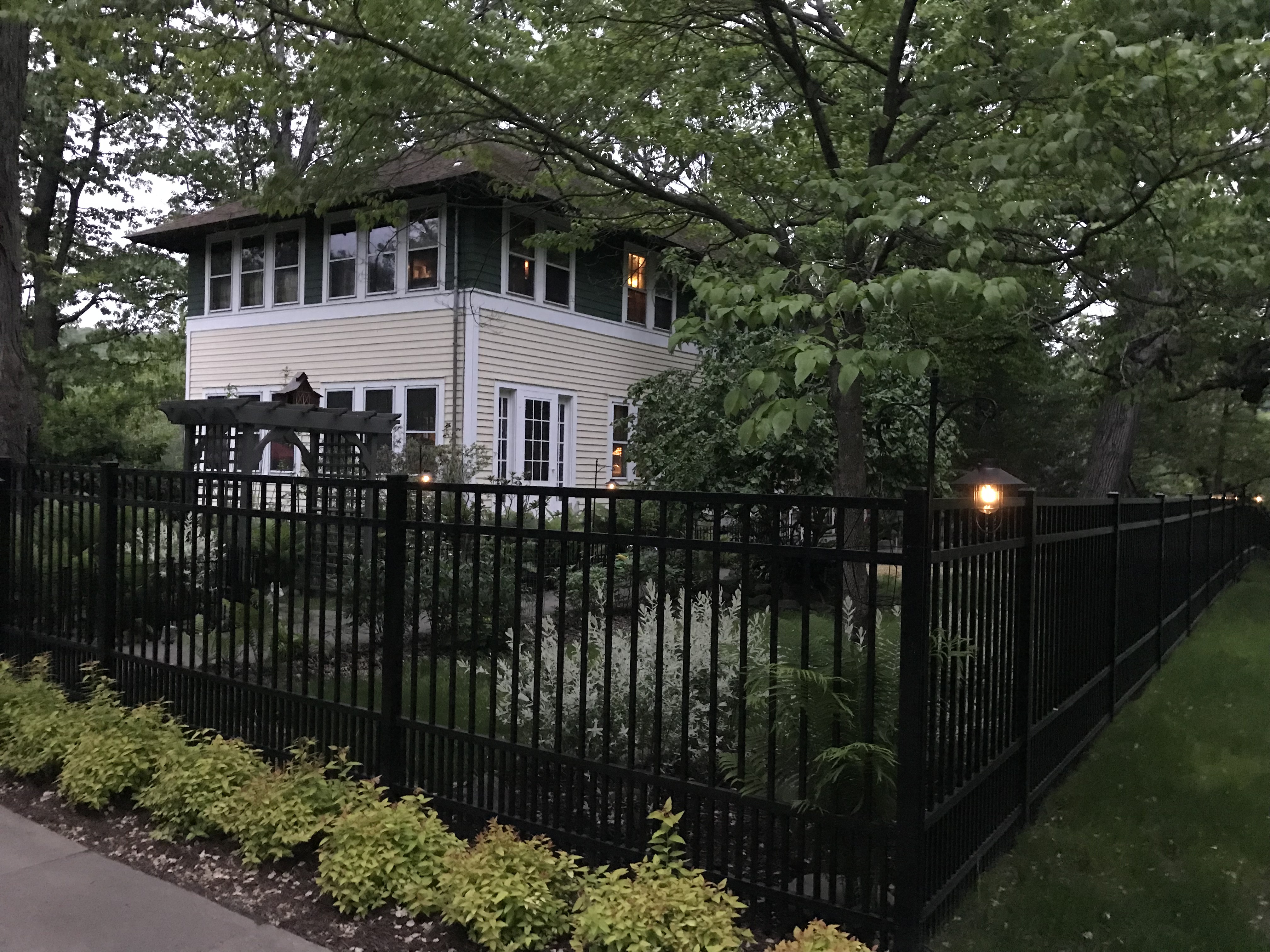
I do my best writing after midnight, in secret, in the dead of night in our darkened bedroom with only the glow from my laptop screen for illumination.   That’s the best thing about laptops—you don’t need to have a light on when you write or read.  It all comes pre-packaged in the laptop.

For me as a writer I need not to see what’s around me or hear what’s going on around me.   Ever since I was a boy I really did my best work at night after everyone had gone to bed.  No interruptions, no one asking me questions, no pups needing to go out, etc.  As a grown man I still do my best work after the old schoolhouse clock has struck midnight.

I am not easily distracted but there is something comforting and reassuring about writing quietly in a darkened room when no one is around to watch me or see me doing the writing.  In the darkness, when I look up from the laptop screen, I can visualize the scenes and characters that I am writing about.  Sounds weird, perhaps even eerie, I know, but it’s true.  In the darkness the words I write come alive and take shape right before my eyes.

So, if I write at night in the wee hours what do I do during the day or earlier evening hours?

I like to sleep late.  Always have.  If I go to bed at 9:00 pm I’ll sleep until noon.  If I go to bed at 6:00 am I’ll sleep until noon.  It’s my internal body clock.  I’m a night owl through and through.  Many years ago I learned that IF I’m going to stay up all night I might as well be productive.  I simply do not function in the morning.  Period.

I say that I “sleep” until noon, but that’s not quite true because I still have to get up every couple hours to let the pups out.  Eight dogs have their own internal and external body clocks and their needs must be met.  Luckily, they are pretty much on my night owl schedule as well.  Or, my vampire schedule.  Thank the bees and trees.

Therefore I sleep in roughly two hour blocks of time, get up, go out, wander around for about fifteen minutes and then crawl back into bed with all the pups.   They know that around noon I “wake up” and things are going to begin to happen.

Hot shower, brush my teeth, make coffee.  Then the pups go for a good long walk in the woods and burn off all their pent up energy from the long night of sleeping.

From about 1:00 pm on we are in the Breakfast Room at Henwoodie or at the kitchen table here at John’s house.  The pups eat a bit, play, tussle, and I do research, read, reply to emails, answer pressing queries from my editors and art directors.  This takes up the entire afternoon pretty much.

The pups eat dinner exactly at 6:00 pm.  I watch the PBS Newshour, have snacks and a Pellegrino mineral water and putter around online—chatting, looking things up, checking to see what friends and family are up to on FaceBook and begin to get ready for a long night in the studio.

I generally draw and paint from around 8:00 pm until 3:00-4:00 am (if I’m not writing).  After spending so many hours at the drawing board I unwind by crawling into bed with another Pellegrino and my laptop and will write for at least an hour or two.

Then sleep.

And that’s my writing schedule pretty much.  Think and read during the day; draw, paint, and write at night.  Darkness is this writer’s best friend.

Quiet.  Quiet is the night.   All things alive mock death by sleeping. Sleeping peacefully through the quiet, quiet night.  And I write in the quiet, quiet night.

Journaling…

Standard

While driving home from the grocery store here in Dearborn I was listening to the Detroit NPR station.  NPR is the ONLY radio station I listen to when driving (otherwise I listen to a great audio book—love love LOVE Audible!).   The program was interviewing a local Detroit writer/poet and I was dismayed to hear the interviewer say “So what made you start journaling when you were five years old?”

Journaling???  I hate this word/verb more than I detest the word “dude”.  There are just some words that are “fingernails on the blackboard” to my ears.  And ‘journaling’ is right at the top of the list.

I remember the first time I heard a teacher use the word journal as a verb when talking to a student:  “Did you journal today?  You know, it’s important to keep journaling every day.”  I almost fell over in shock and horror at the use of what used to be one of my favorite words: journal.

You write IN a journal.  You can even KEEP a journal (hidden or written in).  You might even maintain a journal.   To me the word “journal” is, and always will be, a noun.  I write in my journal everyday.  Well, almost every day.  My life isn’t so exciting that it requires daily documentation, believe me.

If I could have one wish granted it would be to have writers, teachers, students, and especially children STOP using the word “journaling”.

I’m sitting here laughing at myself because I almost have the same gut reaction to the word “author”.  I still prefer “writer”.  I write.  I do’t auth anything.  I suppose it really comes down to semantics and pickiness.

I love writing too much and it bothers me when people water down the activity of writing by creating nonsensical words like journaling to describe the act of writing in a journal.  And I think I know why.

Journaling sounds so much less intimidating than writing.

But then I ask myself “Why are people so afraid to write and the activity of writing?”  Anytime someone says to me “Oh, I can’t write.  It’s beyond me.”  My reply is: “IF you can tell a joke and get to the punch line in due course, you can write.”  There is no great mystery to writing.

It really is very much like knitting or stringing beads or pearls: You simply select the best words and keep stringing them together to tell your story, make your point, tell a lively joke.

It saddens me that so many people associate writing as something no really very enjoyable to do.  I often quote Gertrude Stein whenever I talk about my own writing: “I write for myself and strangers,” she wrote.  And it’s true.  I do the same.  I don’t think anyone gets near the enjoyment out of my writing, my words, that I do.  I simply like them.

I like the way they look on the page, on my laptop screen, or in a book.  I like way words look.  Period.  The same way I like the way old books smell when you open them.  Or the feel of the paper in old books that has so much texture and heart.

When I write with a pen or pencil I like the sound it makes as I scratch the words onto paper.  There is something so satisfying about that sound and feel of writing.   I like the shape, the heft, and design of a beautiful pen.   I still love to write (and draw) with my 1960 Extra Fine nib Mont Blanc fountain pen.  I love mixing my own inks for this fine instrument (pitch black ink sometimes bothers me so I like to make a more watered down dark grey/sepia ink to put in it).

Writing is cathartic.  Writing is meditative.  You have to consider the value of each and every word and whether to use any particular word in any particular sentence at any given time.

Here are some of my favorite words that I strung together when I was eighteen years old and was sitting in a lecture, bored silly:

Two trees stand firm against the bitter wind

a friendship has grown between them.

I simply like these words and the feeling that they convey.  They conjure up a powerful image in my mind and capture the essence as to how I feel about friendship.

Words.  Words are my currency.  And I spend spend spend!

Not Dead…

Standard

I am not dead.  No matter what rumors you hear, this one is not true.   I have been travelling and taking care of John in Dearborn, Michigan after his emergency surgery at the end of January for appendicitis.   Then all the snow came.

And I haven’t really had anything exciting or noteworthy to post.  But inspiration will return.  I have ever confidence of that!

Writing

Standard

I started writing in my first journal when I was twelve years old.  The first thing I wrote was: “My Life Plan” — in pencil on lined notebook paper.   I still have that “Life Plan” and oddly enough, I have stuck to all these many years.  I set out both short term and longterm goals for myself.  I have achieved nearly every one of them.  Short term goals give me the feeling that I CAN accomplish something within this lifetime.  Longterm goals give me the feeling that I still have goals to reach and strive for.  Something to live for.

When I was in college I wrote a lot of poetry.  Most it was maudlin or downright self-indulgent.  But in writing those poems I kept my hopes alive and my sanity somewhat intact.  I printed a volume of the poems and titled it: Poems Written on Rainy Days.  Obviously, ‘rainy days’ were the “down” days; the days when I slipped into the depths of despair and wondered if I would ever be able to climb out.

I still have that bound volume of poems around here somewhere.  I hope to find it as I pack up papers, correspondence, dummies, sketches, etc. for the Kerlan Collection.

Only one poem stands out in my memory; one worth remembering:

Two trees stand firm against a bitter wind;

a friendship has grown between them

I was eighteen years old when I wrote that poem.  Those words still resonate with me today more than forty years later.

One Moment

Standard

Ollie Dead in Leaves            The bare trees huddled close to the wooden house as if to warm themselves from the cheery glow coming from the kitchen window.

Sitting in the kitchen the man stared out the window, thinking.

A fly softly buzzed against the glass seeking its own freedom from his thoughts.

The man picked up his mug of coffee and sipped it without taking his eyes off the trees standing stark against the steely sky.

It was 3:14 in the morning.

The world was hushed and silent as if waiting for something to change.

Something to alter his reality.

Something to make his reality not be.

On the kitchen table sat a small plant.

A winter primrose.

As if unaware of the shift in reality the primrose bloomed bright with yellow flowers. Cheerful and calming as all primroses are.

The fly grew bored of buzzing against the glass and settled on the leaves of the primrose exploring the surface hopefully.

Hope.

I am the eternal optimist, the man thought.

Optimism springs eternal.

Or is it hope springs eternal?

How could this moment be his reality?

The eternal question everyone asks at one point or another in his life. How and why. What had he done wrong?

It had to be a trick.

A trick of the machines.

A trick of the light.

A trick of his hearing.

He must have heard wrong. That had to be the answer.

What had Gertrude Stein said before they wheeled her into surgery?

What is the answer?

And when no one answered she said the most oft repeated line of her career: “In that case, what is the question?”

What is the question?

The man had no answers.

No questions either.

Just the silent reality of the warm kitchen.

The man stood and pressed his forehead against the cold glass that kept the outside world at arm’s length.

He put his hand in his pocket and fingered the bone button that he always carried for good luck.

The button had failed to bring him the good luck he needed most a few hours ago.

A lifetime ago.

Twelve hours ago.

The man took the button from his pocket and held it between his thumb and forefinger.

The smooth texture brought back a flood of memories.

A night in an ancient burial mound.

The discovery of his first skeleton lying on its side, undisturbed.     Unaware.

His reality was that he was too aware.

Too discovered.

Outside, the bare trees shuddered in the wind and scratched at the window with their bony branches.

Scritch. Scritch. Scritch.

The sound brought back memories that would haunt him for the rest of his life.

It would be a brief haunting he thought.

But why now?

Why me?

It made no sense.

Reality made no sense.

He had too much to do.

Too many things to finish.

The fly buzzed back to the window. Desperate to get out, not be trapped in this man’s reality.

But, what was his reality?

His reality was one month.

One month to tie up the loose ends of his life.

The man’s gaze settled on the primrose and he smiled.

How could something so humble bring so much joy?

It was the same with the bone button he always carried in his pocket.

It brought him peace of mind and held all the memories of his life.

The button made him remember.

The button made him forget.

The diagnosis made him regret.

Cancer.

One word.

One diagnosis.

One button.

One fly.

One plant.

One last trick.

Outside the kitchen window the bare trees stood still holding their breath.