Part One: Conversation with Eric Hemmers — Where Did the Idea Come from for ‘The Lay of Moel Eyris: The Saga of the Bear’s Son’?

Standard

Part One:  This conversation is divided into ten parts.

Eric Hemmers: I’m sitting in a quiet café, tucked down a side street, having coffee and pastries with the renowned and internationally acclaimed children’s book writer and illustrator, Olivier Dunrea. I first met Olivier when I was a boy in the mid-1980s and was fascinated by the stories he told, and the slides he showed of his research expeditions to Scotland and the Orkney Islands, as well as of his mythical world of Moel Eyris (Mole Islands). Olivier had a large leather portfolio filled with sketches, colour studies, drawings, watercolours, and most impressive—a large detailed map of his island world.   Finally, I get the chance to ask him all the questions that I had wanted to ask all those many years ago.

Olivier, I have to tell you, it is wonderful to see you again after all these years. When you came to my school as a visiting author I was mesmerized by your stories, humor and tremendous energy. The story you told that I remember and loved most was the one when you had been stranded overnight on one of the more remote islands in the North Sea and had to spend the night in the prehistoric barrow. You made that story so real I felt I was there with you, huddled on that ladder in the pitch black darkness.   And it was great to see the photos you had taken to prove that the burial mound was real! It was because of you that I decided to pursue a career as a journalist and writer.   I’ll never forget you telling us “Words are power! Use them!”

OD: Did I really say that?   It sounds like something I would say. And mean. Thank you, Eric, for being so interested in my work. I appreciate it. The story of my spending the night in the prehistoric barrow is one of the best stories, I must admit.   That barrow is located on the Holm of Papa—a tiny, uninhabited island off the east coast of Papa Westray.   Westray, Papa Westray, and the Holm of Papa are the three remote islands in the northwestern part of the Orkney Islands. That expedition was one of the most memorable during all my years visiting Scotland and the Orkney Islands.

EH: Your stories have stayed with me all these years.   You have a way of telling a story that makes a person live the story as if it’s happening right then to them. You have to be one of the best storytellers I’ve ever met. And your sound effects are the best! If I hadn’t met you I’m not sure I would have been so determined to become a writer myself.

OD: Eric, that is great to hear! And quite a compliment. Thank you. I’ve always said that I probably should have been a motivational speaker or an agent. I’m fairly good at prodding others to accomplish great things.

EH: When I was a boy I always wanted to ask you “Where did the ideas come from for you epic mythology The Lay of Moel Eyris?” but, you were always mobbed by kids and other people, all clamoring for your attention so I never got the chance to talk to you and ask my question. So, I’m going to finally ask my big question to start this interview: Where did you get the idea for The Lay of Moel Eyris: The Saga of the Bear’s Son?

OD: Well, from this point on we can simply refer to the mythology as LOME. Much easier than to keep saying the full title of series. I suppose it’s fair to say that it all started when I was an undergraduate in college, a sophomore.   For one of my English classes I took Children’s Literature. The professor was Dr. Keith Taylor and his love of children’s books, the authors, the illustrators, and energetic style of teaching impressed me beyond belief.   We were required to read 450 children’s books, including picture books as well as middle reader and young adult novels. It was in his class that I first read The Hobbit and The Lord of the Rings.

EH: What year was that? Do you remember?

OD: Of course, I remember.   I’m NOT that old! That was either in the autumn of 1972 or the spring of 1973.   I can’t believe I can’t remember exactly when I took that class! My memory is starting to slip faster than my underwear!

EH: [laughs out loud] See, that’s what I remember about your visit to my school. Your wacky, wild sense of humor! Did you know that you always wanted to be a writer and illustrator?

OD: Yes, pretty much, I think, although I did get sidetracked into theatre and music, which is what I took my undergraduate degrees in and pursued as a graduate student. I quickly learned that I am a much more solitary kind of person and not a group effort kind of guy.   Since I was twelve years old I always wrote in a journal. I also wrote out my “Life Plan” when I was twelve. I was a very focused and determined young boy. Today it’s called being ‘obsessive-compulsive’. In fact, one of my journals that I wrote when I was seventeen years old became the basis for my autobiographical novel titled 4” written under a pen name—Gabe Hooton.

EH: I don’t want to stray too far from LOME, but real quick, what is 4” about and why did you write it under the name Gabe Hooton?

OD: 4” is an edgy and compelling coming-of-age story. It’s based directly on one of my journals with a bit of artistic license taken in order to tell the narrative that I wanted.   I wrote it and published it under the name Gabe Hooton because I didn’t want it to compete with my children’s picture books.   I thought there might be too much of a conflict of interest. And I always wanted to have a pen name. I have several pen names, in fact.

My absence

Standard

Just a very brief post.  On 20 March our beloved Springer Spaniel, Molly, slipped and fell into the Delaware River and was instantly swept away underneath a massive ice sheet.  We are in  deep mourning and I am having a very difficult time coming to terms with her death.

Will post again soon.Molly up close

Where I write

Standard

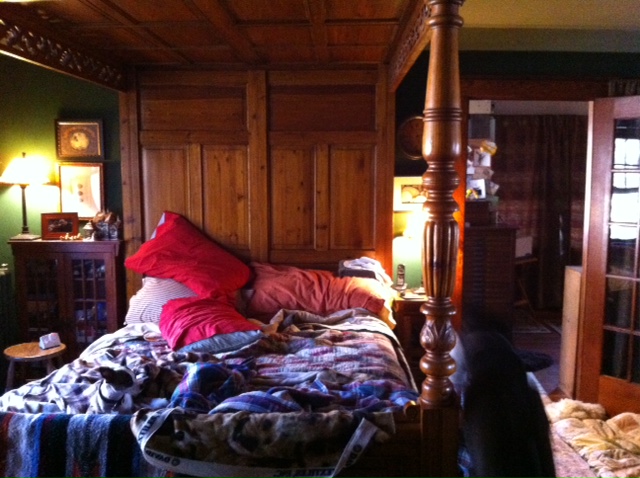
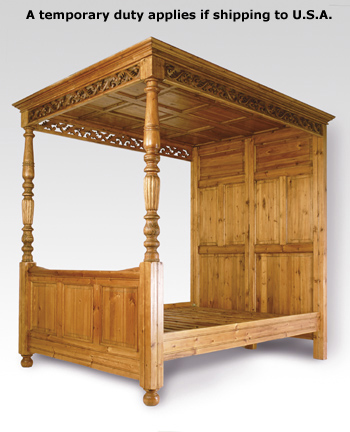
Our bed

This is our bed.  I love it!  I had bought this bed many years ago from a company in Vancouver, BC.  It’s hand carved and majestically sits in our bedroom like a room unto itself.  Or, more accurately, like a railroad carriage.

I do a great deal of my writing in the wee hours of the morning, sitting in bed propped up by a bounty of pillows and surrounded by six wee pups (who are fascinated by the laptop keyboard and all the tap tap tapping away I do on it).

Here’s what the bed looks like in situ:

Bed messy

Looks a bit messy because I jumped out it to snap a quick photo with my iPhone.

When I’m writing I turn off all the lights and do my writing by the glow of the computer screen (how romantic is that!).  And in my mind I imagine myself sitting alone in a darkened railroad compartment that I used to ride in when I first traveled through Europe, England, and Scotland.

There is something very reassuring about sitting in a railroad compartment on a long train ride through darkened landscapes.  You can’t see anything out the windows so your only options are: sleep, read, or write.

I generally chose to write.  There was something about the gentle rocking, and occasional lurching, of the train that was conducive to writing stories.

Our bed is about the same size as a first class old-fashioned railroad compartment and the perfect place to write.  I have fantasized about rigging up some sort of contraption to gently rock the bed to simulate the rocking motion of the train and the synoptic sound of the click, click, click as the wheels of the train clattered on the rails.

Just thought you might like to know what kind of surroundings I like to be in when I write.

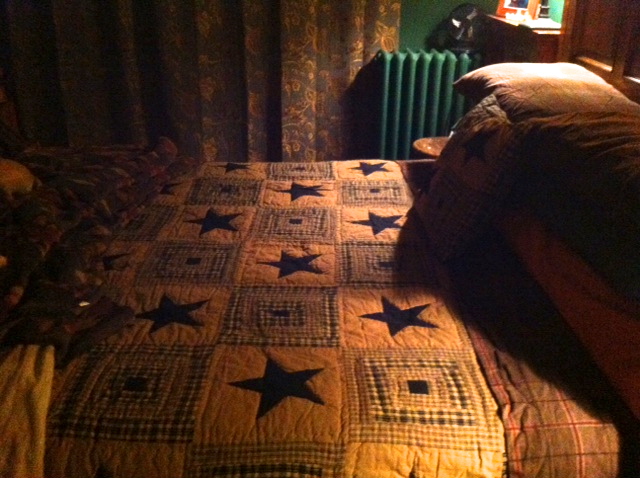
Oh, and here’s the bed nicely made.

New Quilt 1

Settling down…getting to work

Standard

STUDIO UPDATE: Before I can ever settle down to getting serious work done in the studio I always have to fidget, rearrange, find something that I absolutely must find, and draw a map. Just to organza my thoughts.

And I have to look up favorite quotes to urge myself on. Of course, ALL my favorite quotes are kept in my trusty, most beloved, Filofax.

Filofax. How many of you remember these when they first came out? ALL the intellectuals, on-the-go professionals had one (or some variation of it). Mine is about 35 years old. I bought when I first got published. At Bloomingdale’s! (of course). It cost a small fortune. It’s Italian. And I carried it everywhere with me in my leather shoulder bag (naturally).

Filofax

Filofax open

The Filofax is where you kept all your addresses (personal and professional); wrote your notes, carried your specially made Filofax maps of the cities that you absolutely had to find your way around, receipts, entered expenses (business and massage parlor), etc. No one would be caught dead without their Filofax. AND…I only bought my Filofax replacement pages/address pages, etc. in London! I WAS a writer-on-the go, after all.

The Filofax was replaced by the Palm Pilot, then Blackberry, then Smart Phones (iPhones). Everything that I now keep on my iPhone I used to keep in my Filofax. But, I still carry my Filofax in my shoulder bag everywhere I go. I just cannot imagine abandoning it.

It was my best friend, Wayne Wright, who had insisted that IF I really wanted to be a writer I had to, ABSOLUTELY had to, read (and understand) Gertrude Stein. When Wayne was dying from cancer I used to travel from Philadelphia to Boston to be with him. He slept a great deal when he was on chemo and was too tired to talk. So, to keep myself busy I began reading Gertrude Stein. All of is Gertrude Stein books. And her writing did change my life and perspective as to how I perceived myself as a writer.
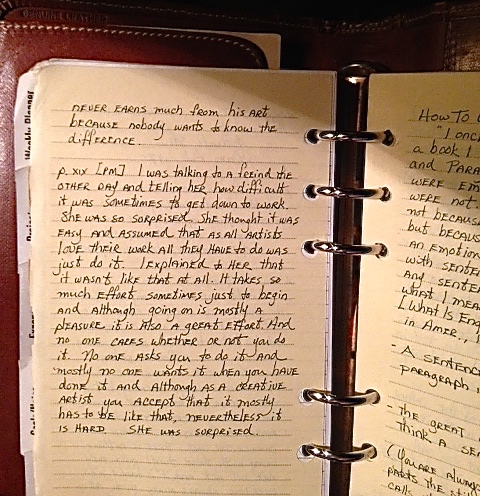
So, tonight I just HAD to find this quote (see photo). It’s reassuring to me somehow. And now I can get down to work.

Quote

I recently discovered that a new friend is a terrific writer!  And he didn’t know it!   I told  him that he must, must, MUST read two books (that every writer should read): The Autobiography of Alice B. Toklas by Gertrude Stein and The Autobiography of Janet Frame (and then watch the film ‘An Angel at My Table’ that is based on her autobiography.

Other books that any writer worth his or her salt that are must reading as well are:  Max Perkins: Editor of Genius by Scott Berg and Dear Genius:The Letters of Ursula Nordstrom collected and edited by Leonard Marcus

Screen Shot 2015-03-12 at 5.16.02 AM

So now that I have read the quote I needed to find I can concentrate on settling down to work in the studio.  Some people  have to sharpen all their pencils before they can begin to work in earnest.  I have to read favorite passages/quotations.

Spring Cleaning

Standard

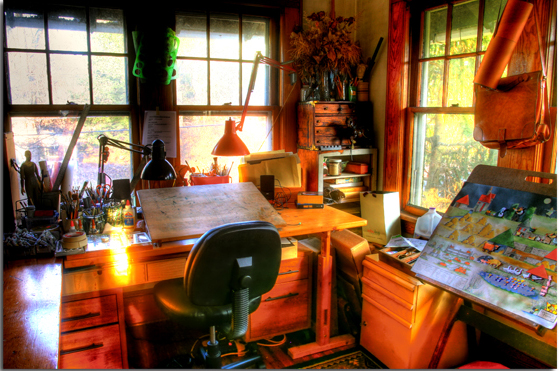
I’m one of those odd ducks (or should I say goslings) that cannot function if the house, especially the studio, is a mess!  Spring cleaning has begun in earnest now that I am back at Henwoodie.

Cluttered Studio = Cluttered Mind and no productivity.

Uncluttered Studio = Uncluttered Mind and lots of productivity!

While I was in Dearborn John and I had gone shopping one day and bought a number of sturdy storage boxes.  I have to keep all my electronic cords and gadgets in one place and off the work tables in the studio.   Larger storage boxes will hold sketches and notes while I’m working on books.  Again, I like to keep things that I’m working on all in one place.

I had also brought quite a few new paintbrushes.  Gouache tends to be hard on watercolour brushes.  I buy inexpensive brushes that I don’t have to worry about ruining.  Whereas with watercolour I only use Winsor & Newton Series 7 sable brushes which can get quite expensive.

The pups are figuring out their spots to lay down while I sit at the drawing board for hours on end.    A small space heater is their personal heat source to keep them comfortable (the studio is unheated) and cozy.  Of course, they have a plethora of fleecy blankets to curl up in as well.  And treats.  And toys.   It’s like having pup daycare in the studio so that I can work done.

A Corner of Studio

Writing dialogue

Standard

Many years ago my best friend, Wayne Wright, who was one of the best writers I know, urged me to “listen in” on other peoples’ conversation in order to hone my skills as a writer whenever I had to write dialogue.  Authentic dialogue, the way people actually spoke, not the way I imagined someone would say something.  He emphasized that this was especially true when travelling abroad.

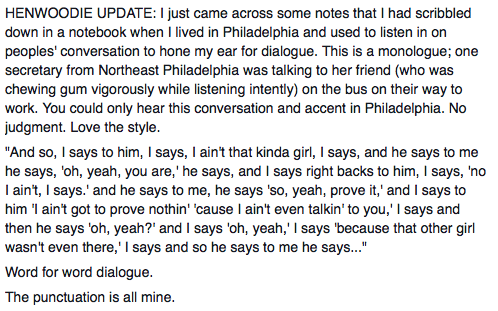
I just came across an old writing notebook with lots of scribbled “dialogue”.

Here is one of my favorites:

Screen Shot 2015-03-08 at 4.18.02 AM

I must admit that NOT being FROM Philadelphia I had never heard this particular kind of speech pattern before.  I became totally caught up in the rhythm and pace of the monologue.  I don’t think I’ve ever scribbled in my notebook so fast because the speaker talked a blue streak!

More on writing

Standard

I can’t remember if I posted this before:  In regard to how I work as a writer (not writer/illustrator)—I might spend nights, days, weeks, even months thinking about the writing I want to do.  I will often lay in bed (just before falling asleep) and will ‘write’ scenes or entire stories in my head.  I either imagine the story in words or I can actually see it frame by frame as movie stills.  Sounds weird, I know.

Night after night I will start from the beginning and think a story as far as I can go.  Often adding new details, new insights, new twists.  I don’t worry about whether the ‘writing’ in my head is logical or not.  I simply tell myself the kind of story I’d love to read…or live!

And once I’ve thought about the story long enough I just know when the right time has come to sit down and do the mechanics of “writing” the story—either with a pen and notebook or on my laptop.

I tend to write the first rough draft all in one sitting.  I don’t think about the writing I just do the writing.  I just let the story come, or, as I’m always telling John “Let the story wash over you.  Don’t anticipate.”

On my laptop, after all the thinking about the writing is done (in my head) I can tap out 10, 15, 20, or more pages in a couple hours.  I’m a fast, accurate typist.   I don’t worry about the technical aspects of the writing at this point: punctuation, grammar, spelling, etc.  I just write.

And I try NOT to think about the writing.

That is the great advantage in knowing HOW to type.  Typing is the most important aspect of the mechanics of writing.   I don’t watch my fingers, I never take my eyes off my laptop screen as I watch the words appear and just let them come.  Not having to think about the mechanics of typing frees my mind up to concentrate on the writing, the storytelling.

It is so painful for me to watch someone struggling with one or two fingers on a keyboard and trying to write at the same time.  HOW can they even think about words when they are so preoccupied with finding the letters on the keyboard.

My advice:  Take two weeks and learn touch typing.  At the end of two weeks you should be able to type at least 35 wpm.

It’s like driving a car.  NO ONE in their right mind would just get into a car and assume they can drive without learning the mechanics of driving.

If you want to write, learn the mechanics of writing.

Trust me, it works.

Writing

Standard

STUDIO UPDATE: Writing is easy. Honest. It really is. It’s the thinking about the writing, coming up with a compelling, provocative, original story line, plot twists, planting clues, not leaving important things out, not putting too much in that is a bit more challenging and difficult (at times). And it is the unthinking the writing when you have to edit, rewrite, revise, edit a bit more, tweak a bit more, go back and rethink the writing that was already thought. Trust me, writing is easy. It’s all the other steps that can be a bit nerve-racking.

Surprise boxes delivered today!

Standard

As a writer and illustrator I tend to work in near complete isolation and solitude (like most writers).   One day merges into the next without any real separation in time and space.

One of the nice things about writing is that you never know what might be delivered to your doorstep.  This afternoon two unexpected, unlooked for boxes arrived from my publisher!

Here’s what was inside:

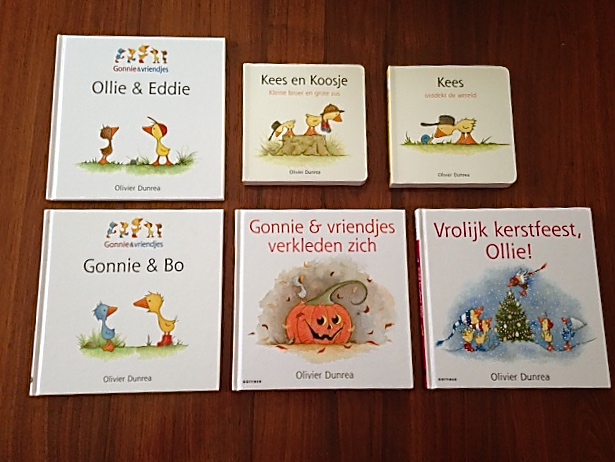
Dutch BooksSix new Dutch editions of existing books as well as Gemma & Gus and Gus!

Gemma & Gus 2

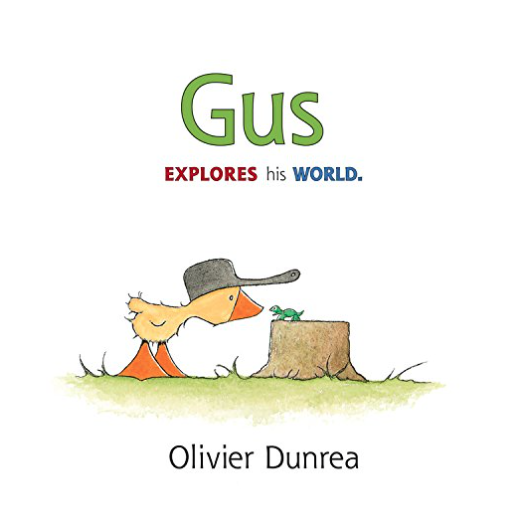
GUS

Both the U.S. and Dutch editions were officially published on 3 March.  You will notice the changes to the front covers that my Dutch publisher, Gottmer, made to the books.  And they put Gus’s name first for Gemma & Gus.

Along with these two brand new books being added to the Gossie & Friends series Gottmer has also published Ollie’s Halloween and Merry Christmas, Ollie!  I had no idea they were working on acquiring the rights to these two books!  I’m thrilled!

When I was in Belgium last year I took the train up to the Netherlands to meet with the folks at Gottmer in Haarlem.  It was a wonderful meeting and I really like these people!   We had discussed the possibility of the holiday books being translated into Dutch, but I wasn’t certain it was going to happen.

The other two books are original creations by Gottmer.  They have combined two separate books/stories into one book!  These editions look great!

Gottmer does quite a bit with the goslings and I am pleased with all that they do.

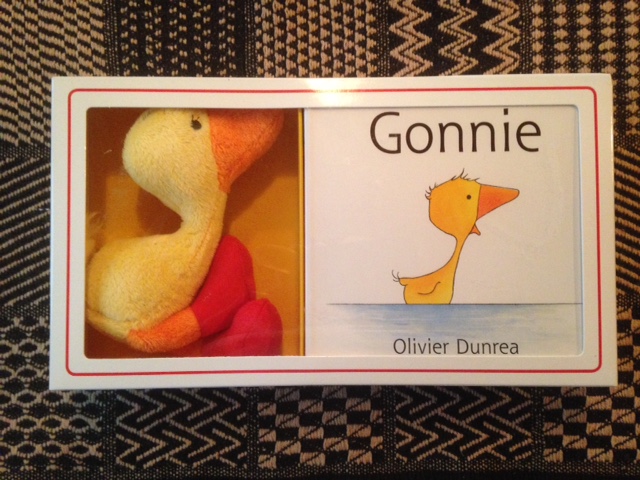
They even produced a stuffed Gossie toy and book combo that you can only purchase in the Netherlands.

Gonnie doll and bookIt’s been an exciting day here in the studio!

Review of “Nobody Likes An Ugly Child”

Standard

Nobody Likes an Ugly Child by Olivier Dunrea

reviewed by Charlotte Delacroix

“The two best things about growing up in a poor family are: First, they have no expectations of you, except that you somehow survive.  And, secondly, they may not be able to read but they are the best storytellers.”  So begins one of the most provocative collections of short stories this reviewer has read in a long time.  The thirteen short stories in this collection tell the painful, often hilarious, and moving trials and tribulations of growing up poor in Chickahominy Ridge, Dismal Swamp, Virginia in the 1950s.

Dunrea’s extended family of parents, brother, sisters, cousins, aunts and uncles, and hardbitten, hard loving grandparents is one of the liveliest and loving families imaginable.  Whereas food and money may be in short supply stories and love never were.   Dunrea’s style is straightforward, unassuming and unsentimental.  Each story recalls a specific incident or time in the author’s life.  Several stories are “remembered” meaning that the story being told happened before the author was born as can be seen in the poignant story titled ‘Littie Pearl.’

In ‘Littie Pearl,’ one of the family’s favorite stories to tell time and time again, Dunrea tells the heart wrenching story recalling the birth of his cousin, Littie Pearl. One hot, summer day as his parents, grandparents, and aunts worked under the broiling sun in the fields in the mid-1940s one of the aunts, Aunt Mildred, goes into labor.   She is told by her father to “Mildred, honey, take a break, and go on and squat under that pecan tree and have that baby.  Your Mama  can help you if you need it.  There’s a an old shoebox in the back of the truck that you can put the baby in.   Then you get on back to work.  If’n that baby’s still alive at the end of the day, you can name it, and we’ll take it home.  If it dies, we’ll just bury it under the pecan tree and won’t say no more about it.”   The baby lives and is named Littie Pearl.

Each story is like a pearl.  Each one is a gem unto its own right.  When they are strung altogether into a complete strand a lively and detailed portrait comes to light of the author’s “dirt poor” childhood and his loving, if somewhat eccentric and erratic family.

‘You Don’t Know You’re Poor Until Someone Tells You’ tells the story as to how the author first learns at school that he is “dirt poor” from a teacher.  “Boy, you ain’t nothin’ but dirt beneath my feet and you ain’t never goin’ to be nothin’ but dirt beneath anybody’s feet.”    With no hint of self pity or regret Dunrea reveals the depth of his family’s poverty.  It occurs to him that it is a bit strange that the women and older girls in the family never actually sit down at the table and eat with the family.  Food is served first to the men and older boys with the younger children left to scramble for whatever is leftover.  It’s not until the author  heads off to college that his mother reveals the secret as to why the women in the family never starved to death.  “Oh, hell, son,” Mama said as we drove north on Rt. 13.  “We picked and nibbled the whole time we were cooking.  We were always hungry, but we weren’t starving.”

In the story ‘He’s Being Beautified’ the painful reality of not being a very attractive child is told in a humorous and no nonsense child’s voice when the author first starts school at the age of five.  His cousins and sisters attempt to tame his “big ass ears” with Scotch tape and the admonition that “Nobody’ll notice your ears are taped back.  Don’t embarrass us.”   Throughout the stories the recurring theme of “don’t embarrass us” is woven seamlessly into the narrative.  What the family lacked in money and education they more than made up for with “pure stubborn Southern pride.”

In the story titled ‘This Li’l Chile,’ the author recalls the time at the age of four when he puts his hands on his hips and announces to his family that “This li’l chile is NOT going to stay in this swamp.  This li’l chile is moving to town.”  And sets off down the dirt road to find the town.  Throughout the author’s childhood he longs to live a life vastly different from the one he lives in Dismal Swamp.

Whether telling the emotionally charged story of one of his favorite uncle’s death, and how his aunt tried to climb into the coffin with him, to his mother’s insightful understanding of her son’s need to express himself and be different, these stories never disappoint.  In ‘No Eggs Will Die’ when, at the age of five, the author takes a dozen cold eggs out of the ice box (the family did not have a refrigerator) and puts them in a “nest” made from his old, tattered quilt.  “After I got all the eggs arranged just right I pulled down my pants and underpants and sat on them.  I don’t know why I thought I had to be naked to hatch out the eggs.  Somehow it just seemed like the right thing to do.”  He proceeds to pull down his pants and sits on the eggs only to be shocked by their coldness and breaks them all.    His mother’s “WHY are you so strange?” is repeated time and time again with love and patient exasperation.

‘Sunday Potato Chips’ tells how every Sunday one of the uncles bought a “big bag of Wise’s Potato Chips” to the grandparents’ house, where everyone gathered for dinner, and the once a week special treat of eating potato chips.  “We kids would sit on the floor lined up like China dolls waiting for Uncle Ray to count out each one’s fair share of potato chips.  It was never more than four or five chips and it was never enough.  Each of us placed a chip in our mouth and savored the salty taste.  We tried not to chew so as to make the potato chip last longer.  To wash down the salty potato chips each of us was allowed one sip from a bottle of Coca Cola.  We kids lived for those Sunday treats.”

Childhood and adolescence is never an easy time for anyone.  Dunrea relates one of his deepest regrets in life in ‘Why Do You Always Embarrass Me?’  When he was in high school his mother arrived to pick him up with curlers in her hair and was wearing  a “sad, worn out dress.” The author’s first words to her were “Why do always embarrass me so much in front of people?” He continues his attack with “And your Southern hillbilly accent is just as embarrassing.  Why can’t you talk properly?”  These words come back to haunt him many years later when he becomes a published writer and invites his mother to attend book signings, television interviews, and public speaking events, but she always has an excuse as to why she cannot attend.   Finally, when pressed as to why she can’t attend a particularly important award presentation, she tells him.  “I don’t ever want to embarrass you in front of people.”

Those words haunt the author from that day on.

Nobody Likes an Ugly Child includes stories with titles such as ‘Aunt Mary and Uncle Max,’ ‘Wild Pigs, Wild Times,’ ‘Granddaddy’ and ‘Um, How Do You Say Your Name Again?’

Story by story, pearl by pearl, Dunrea lets the reader get to know  him and his “crazy” family, as he likes to put it.   As we get to know granddaddy, nanny, mama, daddy, and a bevy of cousins and siblings, aunts and uncles, each one adds to the richness and liveliness of these stories.  Each voice, each story rings true and is told in a lively, staccato style.

The title of the collection is taken from the signature story titled ‘Nobody Likes an Ugly Child.’ Dunrea reveals that the word “ugly” in the South has a double meaning: not attractive or, as in referring to a child, misbehaving.  “Don’t act so ugly,” is a refrain that is heard throughout these stories.   When the author was two years old he recalls the time when his granddaddy called him over.  Thinking he was going to be given a treat “I waddled over to granddaddy on my short, bowed legs.  I was not an attractive child by any stretch of the imagination.  My granddaddy looked at me, I looked at him, expectantly waiting for something sweet to be offered.  Instead of the expected treat Granddaddy backhanded me hard across the face and said ‘That’s just for being so ugly.’  Mama, running to my defense said ‘Oh, daddy, I know he’s ugly, but don’t keep telling he’s ugly.’  I quickly learned that if you are the ugly child life is going to be rough.  And it’s best to discover what your talent is as soon as possible.  I discovered that I had two talents: I could run fast and I could read and write.”

In the final story ‘I Won’t Embarrass You’ Dunrea leaves his poor Southern family in order to pursue his lifelong dream of going to college ‘Up North.’   He never looks back.

The author states that his “wild imagination and love of stories, and later, books, saved his mental sanity” through all the chaotic insanity of growing up poor.  “We really were dirt poor, as I slowly came to accept.  Stories were our lifeline.  What we lacked in money we made up with in words.  Words were our currency.    And my family could spend with the best of them.” 

I thoroughly enjoyed my time with this quirky and ribald family.   I shared their triumphs and their tragedies as if they were my own.  Nobody Likes an Ugly Child is one of those short story collections that you hate to see come to an end.  We can only hope that Dunrea will share more of his family’s stories with us.